

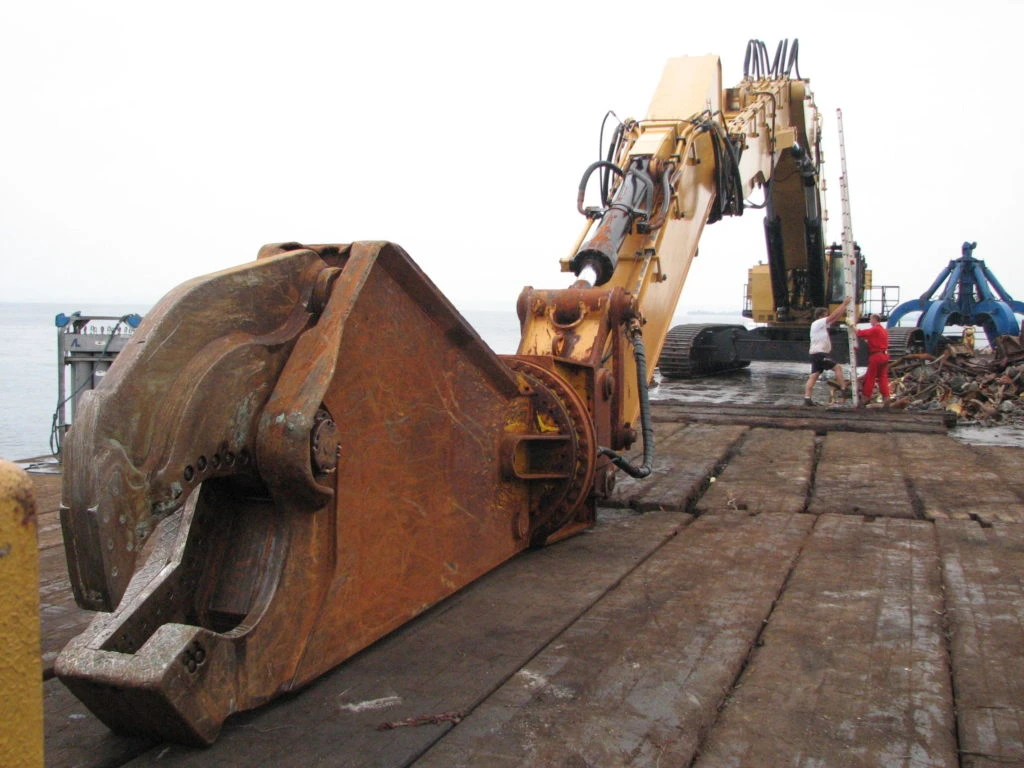
The services of EMHA’s metallurgical department are frequently called upon in disputes. In this case, it involved an enormous “shear” used to cut up shipwrecks in shallow water.
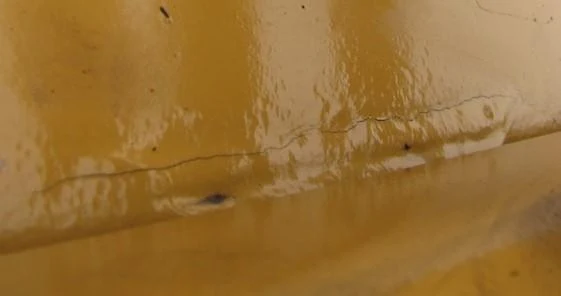
After only a few months of use, cracks began to appear at various locations on the boom. The insurance company involved was uncertain how to handle the costs of this failure, particularly since this was not a standard off-the-shelf item. EMHA was brought in to evaluate the failure, and more specifically its cause. During a site visit and inspection of the crane, it became apparent that an important aspect of the damage lay in the definition of its intended use. The manufacturer had designed a cutting tool suitable for cutting through steel plates. The end user had ordered a demolition tool, which they used for cutting, pulling, lifting and more. Some of this was unavoidable, as the tool frequently became stuck underwater and had to be pulled free from the wreckage it was cutting through.
Our investigation clearly identified fatigue as the cause of the cracks. However, the question remained: would the cracks also have occurred during use as defined by the manufacturer? In other words, would cutting alone lead to fatigue? After the crane was returned to the Netherlands and repaired, we fitted the boom with strain gauges and simulated “normal” use. The measured stresses were compared with predictions from a finite element model. These stress measurements revealed that the stress levels were fairly high, but should not have led to cracking within such a short timeframe.