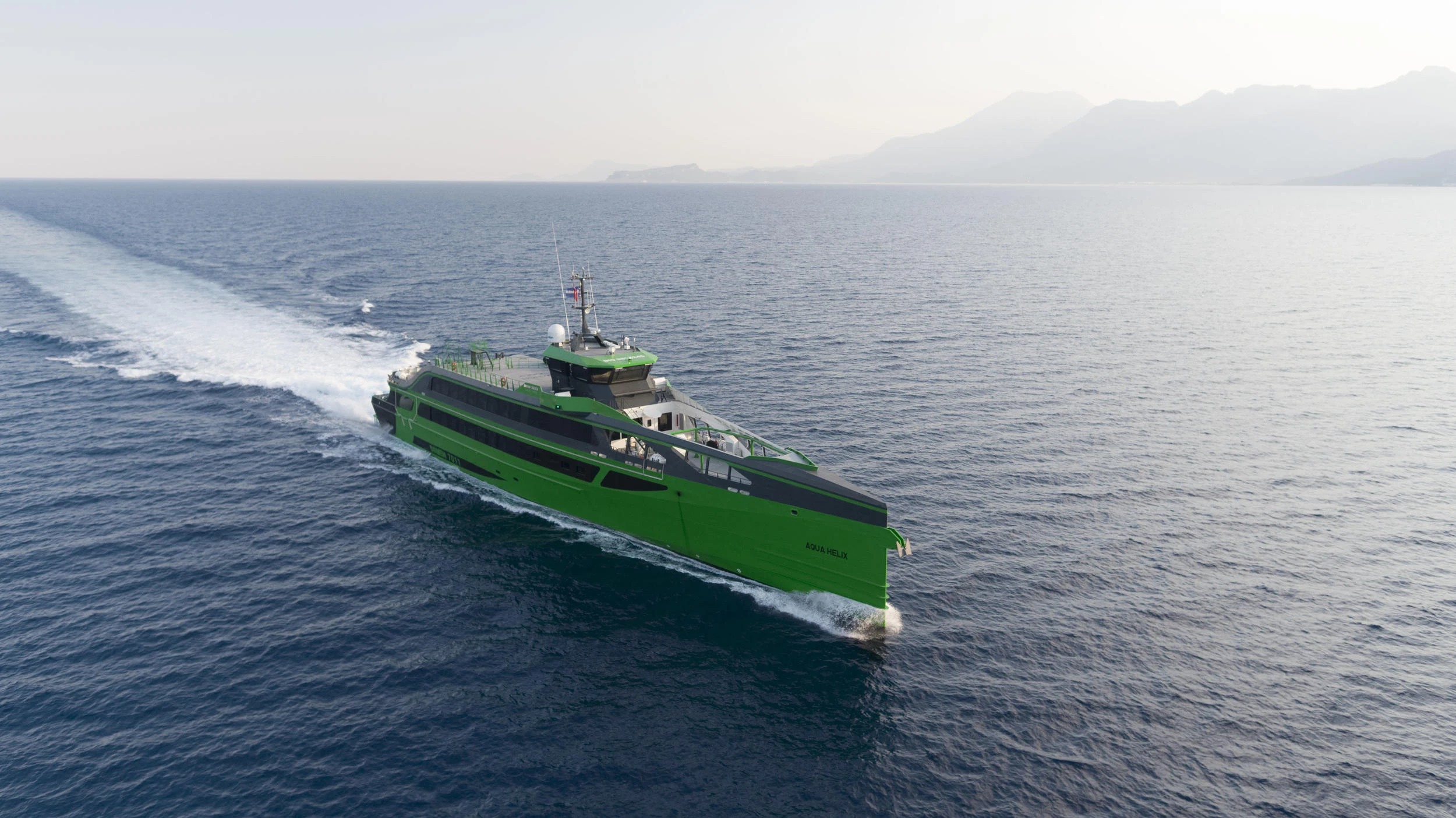




In collaboration with Damen, EMHA developed and implemented an advanced ship structure monitoring system aboard the Fast Crew Supplier (FCS) 7011. This system provides real-time insight into the loads on the ship structure. The result is a data-driven approach to maintenance, service life management and design optimisation.
Situation
The FCS 7011 is designed for high speeds and intensive use under dynamic maritime conditions. This places additional demands on the structure, particularly in terms of fatigue of welded joints. For Damen and the eventual ship owner, it was crucial not only to rely on theoretical design models, but also to gain real-time insight into the actual loads during operations. The objective was to safeguard structural safety, accurately predict fatigue life and optimally plan maintenance and inspections.
Approach
EMHA developed and installed an integral monitoring system directly linked to the Damen Triton platform, in which all relevant ship data is collected. This creates a single central environment in which operational loads and structural response can be continuously monitored.
In addition, working closely with Damen, EMHA applied innovative Fatigue Damage Sensors (FDS) to critical and fatigue-sensitive joints in the ship structure. These sensors measure the actual load at these locations and form a direct link between field data and theoretical models. By combining this data with FEM calculations, we can make an accurate prediction of the remaining fatigue life of specific structural components.
Result
With the implemented system, the ship owner has continuous and reliable insight into the structural load of the vessel. This makes it possible to optimise maintenance and inspection intervals in a targeted manner, rather than basing them on fixed conservative assumptions. In addition, the collected data contributes to further improvement of the design of fatigue-sensitive joints in future vessels. This creates a direct feedback loop between design and practice. The result is a longer service life of the structure, higher operational reliability and lower maintenance costs, without compromising on safety or performance.